10 Massages and Stretches for a Frozen Shoulder
June 15, 2023
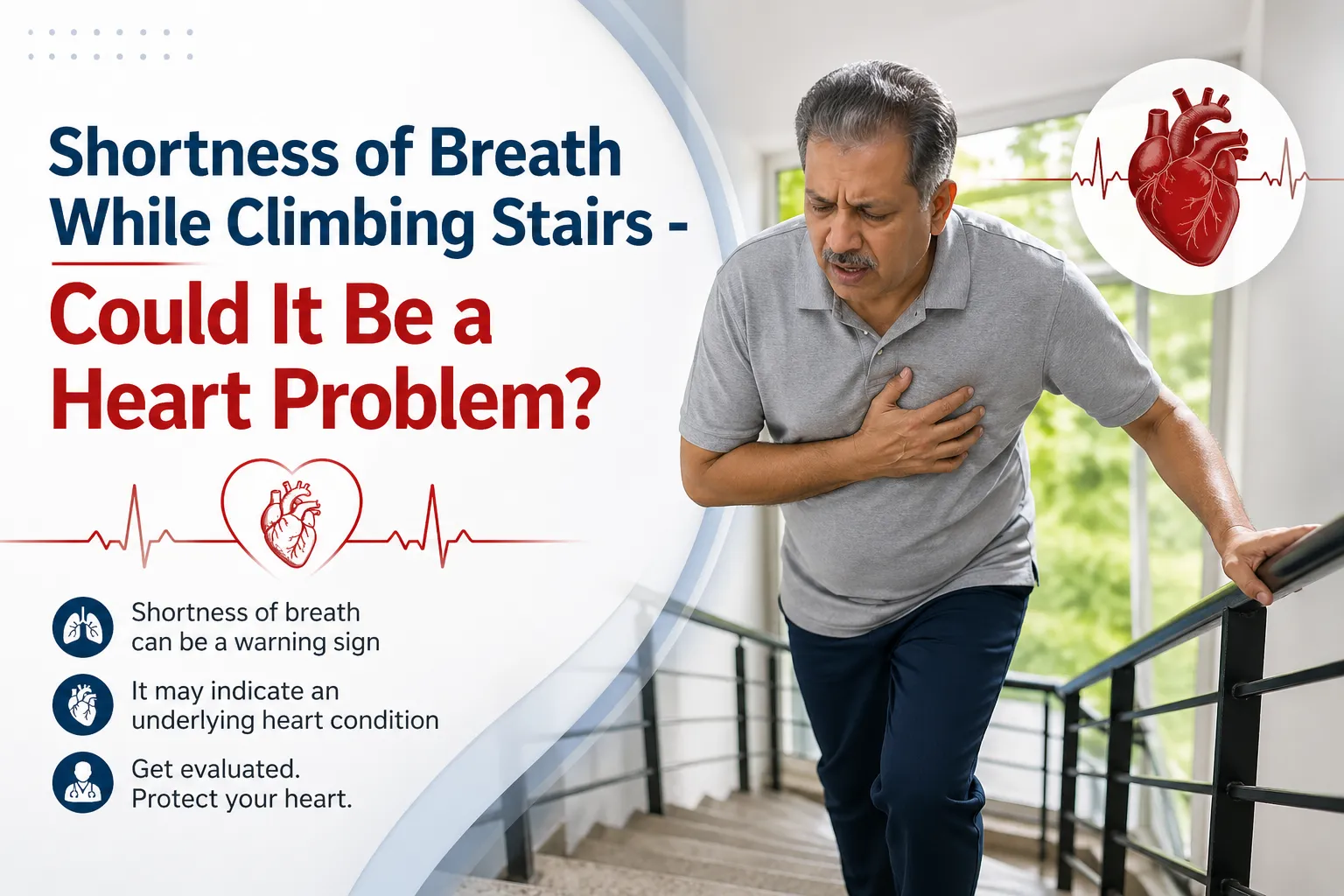
You manage the first few steps fine. Then, halfway up, something changes. Your breathing quickens. Your chest feels heavier. By the time you reach the top, you are standing there catching your breath while everyone else has already moved on. It happens every time, and lately it is getting worse.
A lot of people brush this off. They tell themselves they are just out of shape, or that the heat is getting to them, or that they have been sitting at a desk too long. And sometimes, honestly, that is exactly right. But sometimes it is not. And knowing the difference matters more than most people realise.
As a cardiologist practising in Hyderabad, breathlessness on exertion is one of the most common reasons patients come to see me. It is also one of the most misread symptoms there is. The purpose of this article is to walk you through what is actually going on when you feel winded on a staircase, which causes are benign, which are serious, what we do to investigate it properly at Germanten Hospital in Attapur, and when you need to act urgently.
Climbing stairs is harder on your cardiovascular system than most people appreciate. In the space of a few seconds, your muscles demand a significant surge in oxygen-rich blood. Your heart has to beat faster and pump harder almost immediately. Your lungs have to exchange more gas per minute. And your blood vessels have to dilate to deliver that blood to where it is needed.
If your heart is working perfectly, you will reach the top of a single flight mildly out of breath at most, and recover quickly. If something is limiting your heart's ability to respond to that demand, stairs expose it. This is actually one reason cardiologists pay close attention to stair-climbing capacity. It is a surprisingly reliable functional test.
The formal version of this is a treadmill stress test, where we gradually increase workload and watch how the heart responds. But your daily staircase is an informal version of exactly the same thing. If you could manage it easily six months ago and now you cannot, your heart is telling you something has changed.
Not every case of stair-related breathlessness is cardiac. But many of the non-cardiac causes still need medical attention, and some overlap with heart conditions in ways that require a proper evaluation to untangle. Here is the range:
Table 1: Causes of Breathlessness on Stairs
This is the question I get asked constantly. And I want to be honest with you: it is genuinely difficult to tell from symptoms alone, which is exactly why investigations matter. That said, there are clinical patterns that point in one direction or the other.
Table 2: Distinguishing Cardiac, Respiratory, and Deconditioning-Related Breathlessness
There is one pattern I want to highlight separately because it is so significant and so often missed: orthopnoea. This is breathlessness that gets worse when you lie flat and improves when you sit upright. If you have started sleeping propped up on two or three pillows because lying flat makes you feel like you cannot breathe, that is a cardiac red flag until proven otherwise. It strongly suggests fluid is backing up into your lungs when you are horizontal, which is a hallmark of heart failure.
Most breathlessness on stairs is not an emergency. But some of it is. Here are the warning signs I want every patient to know:
I want to be especially clear about breathlessness that comes with chest discomfort during exertion. This combination is a potential cardiac emergency, and it warrants same-day evaluation, not a wait-and-see approach. Please do not dismiss it as acid reflux or muscle ache and hope it goes away.
Heart failure is probably the cardiac condition most closely associated with exertional breathlessness. I should explain what heart failure actually means, because the term frightens people in ways that are not always helpful.
Heart failure does not mean your heart has stopped or is about to stop. It means your heart is not pumping as efficiently as it should be, so it struggles to meet your body's oxygen demands, particularly during physical activity. Fluid can accumulate in the lungs (causing breathlessness) and in the legs (causing ankle swelling). It is a chronic condition that, when diagnosed and treated properly, can be managed very effectively.
The key point is this: early heart failure almost always announces itself through exertional symptoms before it causes symptoms at rest. Breathlessness on stairs is often the first thing patients notice, months before they feel breathless just sitting in a chair. That is exactly why catching it at the stair-climbing stage is so valuable. Treating it early gives far better outcomes than waiting until rest-time symptoms appear.
We measure heart function using a metric called ejection fraction, which is the percentage of blood the heart pumps out with each beat. A normal ejection fraction is between 55 and 70 percent. We measure this with an echocardiogram. If yours is reduced, it tells us something important about how your heart is performing under load.
When a patient comes to me with breathlessness on exertion, I do not jump straight to tests. I want to understand the complete picture first: when exactly it started, how it has changed over time, whether it is getting worse, what else is going on in your health, your medication history, and your lifestyle. That clinical picture already narrows things down considerably.
From there, here is the investigation approach I typically follow:
Table 3: Investigation Pathway for Exertional Breathlessness
For most patients, an ECG, echocardiogram, and a panel of blood tests give us the diagnosis. The echocardiography test in Hyderabad is particularly valuable because it lets us visualise the heart directly: we see how the chambers are moving, how the valves are functioning, and whether there is any fluid where there should not be. It is painless, takes about 20 to 30 minutes, and provides an enormous amount of information.
Good to Know: A single normal ECG does not rule out a cardiac cause for your breathlessness. Many serious heart conditions produce a completely normal resting ECG. If your symptoms are significant, an echo and a stress test are more informative.
A lot of patients are anxious about what a cardiac evaluation actually involves. Let me demystify it. Your first appointment will almost always start with a detailed conversation about your symptoms. I will listen to your heart and lungs with a stethoscope, check your blood pressure in both arms, and examine your legs for swelling or fluid retention.
If I need an ECG, it takes about five minutes and is completely painless. We place electrode stickers on your chest, arms, and legs and record 10 seconds of your heart's electrical activity. The echocardiogram involves lying on a couch while a trained sonographer uses an ultrasound probe on your chest wall. There is no radiation. It is the same technology used to image babies during pregnancy.
If we need a treadmill stress test, you will walk on a treadmill while connected to an ECG monitor. The speed and incline increase gradually. We monitor your heart rhythm, blood pressure, and symptoms throughout. Most patients manage 8 to 12 minutes. We stop when you reach the target heart rate or if any concerning changes appear. It is not a test of fitness; it is a test of how your heart's electrical activity and blood flow respond to demand.
I also want to address something I see in Hyderabad specifically. Many patients come in after years of managing breathlessness with antacids or inhalers prescribed without proper cardiac evaluation. There is a genuine overlap between heart failure symptoms and acidity or asthma, and it is not uncommon to find a cardiac cause that has been missed because the symptoms pointed in a different direction initially. If you have been treated for something and it is not improving, please do not accept that as the final answer.
If we identify a cardiac cause for your breathlessness, the treatment depends entirely on what we find. The approach is specific to the diagnosis.
One thing I always emphasise to my patients: finding the diagnosis is almost always reassuring, not frightening. Yes, it means something needs to be addressed. But knowing what it is and having a clear treatment plan is enormously better than years of wondering and worsening.
Table 4: Urgency Guide for Breathlessness on Stairs
Hyderabad has a population profile that makes cardiac breathlessness particularly worth investigating thoroughly. The city has a high prevalence of type 2 diabetes and hypertension, both of which accelerate heart failure and coronary artery disease. IT professionals working long sedentary hours, high-sodium diets, disrupted sleep, and the city's intense summer heat all contribute to a cardiovascular risk environment that is higher than many people appreciate.
I also notice a seasonal pattern: the months of March through June bring a sharp rise in patients presenting with worsening breathlessness. Dehydration in summer heat increases blood viscosity and can stress an already-compromised heart. If you have borderline heart function, the summer months will often be when it becomes symptomatic.
The best cardiologist in Attapur is not necessarily the one who orders the most tests; it is the one who listens carefully, orders the right tests, and explains your results in plain language. That is what we aim for at Germanten Hospital.
Breathlessness while climbing stairs sits in that uncomfortable middle ground: common enough that most people dismiss it, serious enough that dismissing it can be a mistake. The staircase is one of the best early warning systems your body has. When it starts flagging something, it is worth taking seriously.
Heart palpitations treatment in Hyderabad has advanced. So has cardiac evaluation. Between echocardiography, stress testing, BNP blood markers for heart failure, and sophisticated non-invasive imaging, we can now give most patients a clear and accurate diagnosis quickly. You do not have to guess, and you do not have to manage on your own.
If your stairs have been getting harder over the past few weeks or months, come in. Let us run an echo, do an ECG, check your BNP levels, and find out exactly what is going on. Nine times out of ten, the answer is reassuring and actionable. And on the occasions when it is not, knowing early is always better than finding out late.
Your staircase has been trying to get your attention. It might be time to listen.
Ready to find out what is causing your breathlessness?
If you have been struggling with breathlessness on stairs or during normal daily activity and it has been getting worse, do not put it off. Dr. Mohammed Wasif Azam at Germanten Hospital, Attapur is available for comprehensive cardiac consultations, echocardiography in Hyderabad, stress testing, and specialist second opinions.
Call us today on +91 9000909073 or +91 9989635555, or book online at germantenhospitals.com. Your heart has been patient enough.
References
1. American Heart Association. Heart Failure - Symptoms and Causes.
2. Mayo Clinic. Shortness of Breath - Symptoms and Causes.
3. National Heart, Lung, and Blood Institute (NHLBI). Heart Failure - What Is Heart Failure?
4. McDonagh TA, et al. 2021 ESC Guidelines for the Diagnosis and Treatment of Acute and Chronic Heart Failure. European Heart Journal. 2021;42(36):3599-3726.
5. Prabhakaran D, Jeemon P, Roy A. Cardiovascular Diseases in India: Current Epidemiology and Future Directions. Circulation (AHA Journals). 2016;133(16):1605-1620.
6. Gulati M, et al. 2021 AHA/ACC Guideline for the Evaluation and Diagnosis of Chest Pain. Circulation. 2021;144:e368-e454.
7. Yancy CW, et al. 2017 ACC/AHA/HFSA Focused Update of the 2013 ACCF/AHA Guideline for the Management of Heart Failure. Journal of the American College of Cardiology. 2017;70(6):776-803.
8. The Lancet Southeast Asia. The Burgeoning Cardiovascular Disease Epidemic in Indians. 2023.
9. American College of Cardiology. Echocardiography: A Guide for Patients.