10 Massages and Stretches for a Frozen Shoulder
June 15, 2023
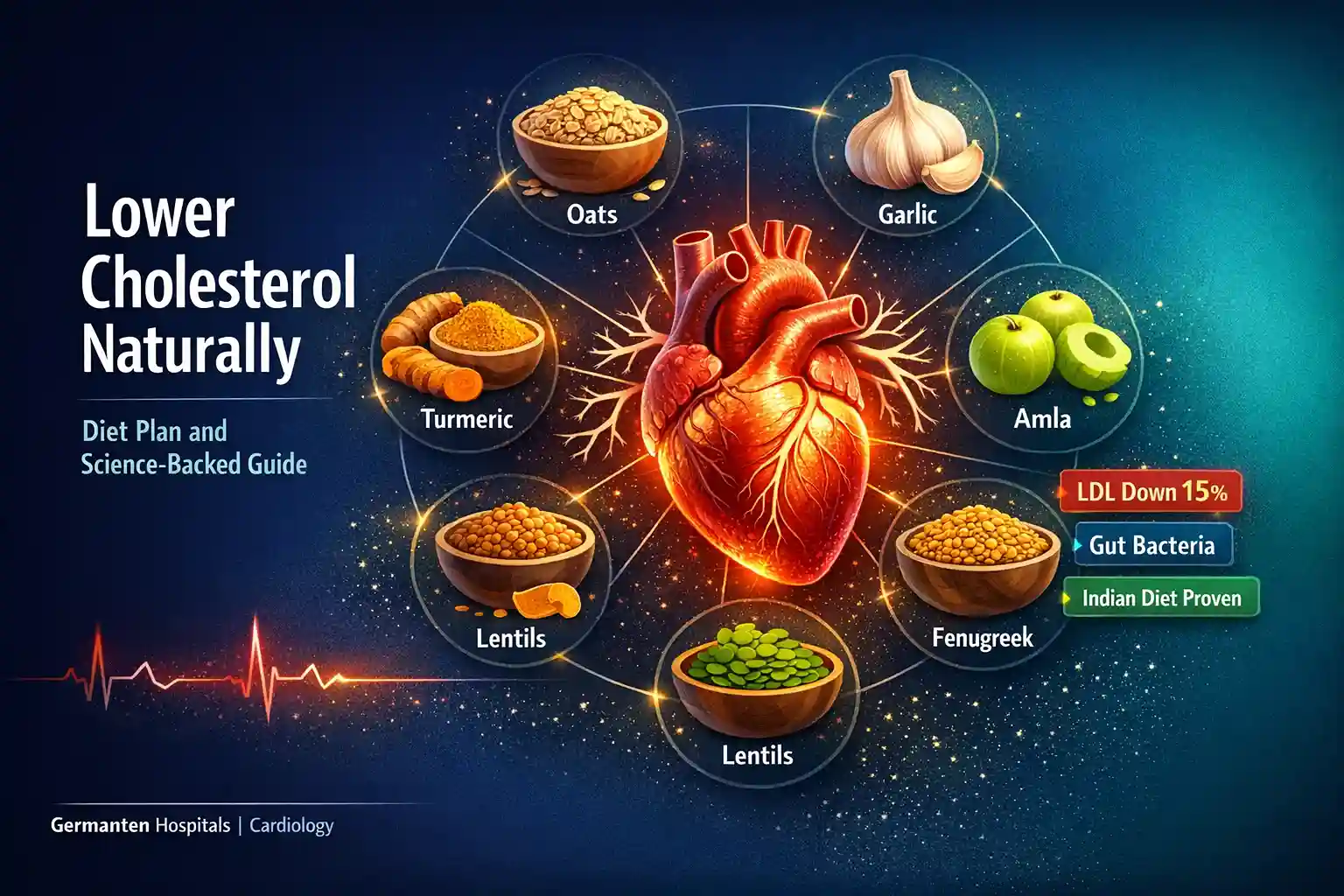
Rajan was 43 years old, a software project manager in Hyderabad, when his company asked him to do a routine health check-up. He felt fine. No chest pain, no breathlessness, no warning signs. But the report that came back stopped him cold: LDL cholesterol at 172 mg/dL. Total cholesterol: 231.
His family doctor looked at the numbers and said, 'You don't feel it, but your arteries might already be silently narrowing. We need to act now.'
What followed surprised Rajan. His doctor didn't immediately hand him a prescription. Instead, he handed him a diet plan. Three months later, Rajan's LDL had dropped to 121. He had not taken a single cholesterol pill.
Here's the truth most people miss: your plate is one of the most powerful tools you have against high cholesterol, especially if you're Indian. And the approach for Indians needs to be different from what you read on most international websites.
High cholesterol is a waxy fat buildup in your blood that quietly clogs arteries, raising your risk of heart attack and stroke. It usually comes with zero warning signs.
As a cardiologist, I see patients like Rajan every week. And I want to give you what most generic health blogs don't: a guide built around how Indians eat, how our bodies respond to cholesterol, and what the latest science says about fixing it naturally.
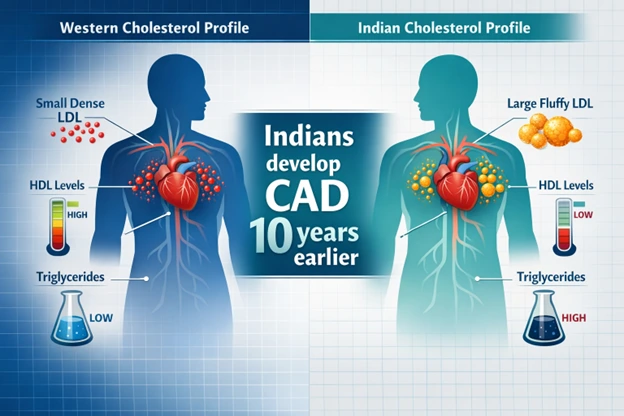
Before we get to the food, you need to understand something important. Indians do not just have high cholesterol. We have a different kind of cholesterol problem.
Research published in the Journal of the Association of Physicians of India (2024) found that Indians develop coronary artery disease (CAD) 10 years earlier than Western populations, even when their LDL numbers look acceptable by standard charts.
Why? Because Indians tend to have:
• Higher triglycerides: blood fats that most people ignore but are just as dangerous
• Lower HDL (good cholesterol), which should be clearing LDL from the arteries but isn't
• More small, dense LDL particles. These are 3x more artery-clogging than large, fluffy LDL, but a standard test won't show you this
• Elevated Lp(a), a genetic cholesterol particle that's especially high in South Indians and is a silent heart attack driver
A 2025 EMR study tracking 7.7 million Indian patients (J Assoc Physicians India, 2025) found that 19.6% were diagnosed with dyslipidemia and a large portion didn't know it. Urban Indians have a 25 to 30% prevalence of high cholesterol, according to PubMed research.
The takeaway: If you're Indian, your cholesterol goal shouldn't just be 'under 200.' The Lipid Association of India recommends LDL targets of under 50 mg/dL for high-risk individuals, which is far lower than most Western guidelines suggest.
Your liver produces about 80% of the cholesterol in your body. The rest comes from food. So changing what you eat affects the other 20% directly, and it also signals your liver to slow down its own cholesterol production.
Soluble fiber forms a gel in your gut. This gel literally binds to LDL cholesterol and bile acids, then flushes them out before they reach your bloodstream. According to the NHLBI (National Heart, Lung, and Blood Institute), eating 10 to 25 grams of soluble fiber per day produces measurable LDL reduction. Most Indians eat less than half of that.
Plant sterols and stanols are natural compounds found in whole grains, legumes, and certain oils. They compete with cholesterol for absorption. Mayo Clinic research confirms that just 2 grams of plant sterols per day can lower LDL by 5 to 15 percent.
A landmark 2024 study published in Cell (Broad Institute of MIT and Harvard), using the Framingham Heart Study data, found that specific gut bacteria can directly consume and break down cholesterol before it ever enters your bloodstream.
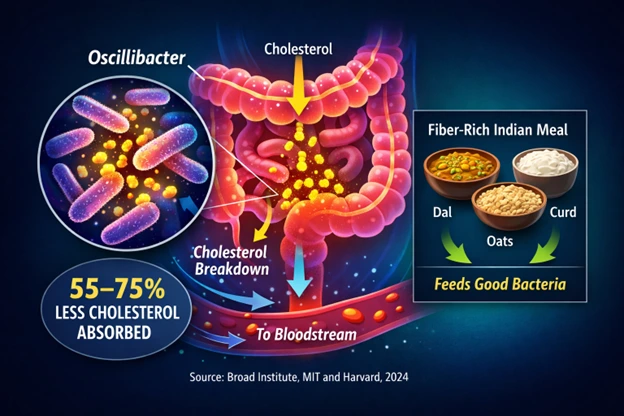
A type of bacteria called Oscillibacter, were found to metabolize cholesterol right in the intestine. People with higher levels of these bacteria had measurably lower LDL and triglycerides. This was confirmed by the NIH's National Heart, Lung, and Blood Institute.
Another gene, named IsmA, found in certain gut bacteria was linked to people excreting 55 to 75 percent less cholesterol in their stool. Their gut bacteria were breaking it down instead of letting it absorb into the blood.
What feeds these bacteria? Dietary fiber. Specifically, the kind found in oats, dal, flaxseeds, and fermented foods like curd. Harvard Health Publishing notes that fiber-rich diets appear to lower heart disease and stroke risk by as much as 30%, partly by cultivating these cholesterol-fighting gut bacteria.
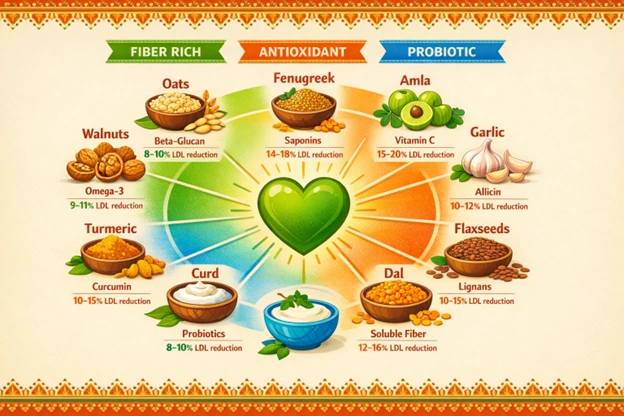
Forget salmon and kale for a moment. Here's what works for Indian kitchens and Indian bodies:
| Food | How It Works | How Much and How to Use |
|---|---|---|
| Oats (Dalia / Jau) | Beta-glucan soluble fiber traps LDL in the gut | 1 bowl daily: oat dalia, oat upma, or mixed into roti dough |
| Fenugreek Seeds (Methi) | Saponins reduce cholesterol absorption; soluble fiber lowers LDL by 14 to 18% | Soak 1 tsp overnight, swallow with water every morning |
| Amla (Indian Gooseberry) | Vitamin C + polyphenols; shown comparable to simvastatin in clinical trial (Indian Journal of Pharmacology, 2012) | 1 to 2 raw amla daily, or 1 tsp amla powder in warm water |
| Garlic (Lahsun) | Allicin compound lowers LDL by 10 to 15%; reduces arterial inflammation | 2 raw crushed garlic cloves on empty stomach, or added to dal or sabzi |
| Flaxseeds (Alsi) | ALA omega-3 fatty acids + lignans reduce LDL and triglycerides | 1 tbsp ground (not whole) daily in curd, roti dough, or smoothie |
| Dal and Legumes (all kinds) | Soluble fiber + plant protein; 1 cup per day lowers cholesterol up to 10% in 6 weeks | At least 1 serving at lunch and dinner: moong, masoor, chana, rajma |
| Plain Curd (Dahi) | Probiotics feed Oscillibacter and other cholesterol-metabolizing gut bacteria | 1 cup homemade curd with lunch. Avoid sweetened packaged yogurt |
| Turmeric (Haldi) | Curcumin reduces arterial plaque buildup and LDL oxidation | Add to all sabzis; golden milk at night with black pepper to increase absorption |
| Walnuts and Soaked Almonds | Monounsaturated fats + plant sterols improve HDL, reduce LDL absorption | 5 soaked almonds + 2 walnuts every morning. Avoid salted or fried varieties |
I find this fascinating as a cardiologist. A clinical study published in the Indian Journal of Pharmacology (2012) put amla head-to-head against simvastatin, one of the most prescribed cholesterol drugs in India. The result was clear: Amla at 500mg/day produced almost identical LDL reductions as the drug, about 10 to 15 percent. At just a fraction of the cost, with zero side effects.
I'm not saying stop your medication. But I am saying: amla deserves a daily place in your life, whether you're on statins or not.
Here's what most health blogs won't say clearly about Indian eating habits:
• Vanaspati (partially hydrogenated fat): still hiding in many Indian bakery items, biscuits, and street snacks. It's pure trans fat. Read every label.
• Refined sunflower oil in large quantities: high in omega-6, which becomes pro-inflammatory when used heavily. Switch to cold-pressed mustard oil or rice bran oil.
• Maida-heavy foods: white bread, naan, puri, bhatura, paratha made from refined flour. These spike blood sugar, which drives the liver to make more cholesterol.
• Sweetened tea (chai) 4 to 5 times a day: the fructose in excess sugar raises triglycerides significantly. This one habit alone can add 20 to 30 points to your triglyceride count.
• Packaged namkeen, bhujia, chakli: ultra-processed, loaded with refined oil, salt, and often palm fat.
Most cholesterol advice says 'use olive oil.' That's impractical for most Indian cooking. Here's a realistic guide:
| Oil | Best For | Cholesterol Impact |
|---|---|---|
| Cold-pressed mustard oil | Tadka, sabzi, stir-fry | High in ALA omega-3; anti-inflammatory; actively supportive |
| Cold-pressed groundnut oil | High-heat Indian cooking | Good fatty acid balance; better than refined options |
| Rice bran oil | Deep-fry (occasional use) | Oryzanol compound slightly lowers LDL; good smoke point |
| A2 cow ghee (1 to 2 tsp/day) | Rotis, dal tadka | Minimal LDL impact in small quantities within a high-fiber diet |
| Extra virgin olive oil | Low-heat dishes, chutneys | Best for LDL; not ideal for high-heat Indian cooking |
| Refined sunflower or 'vegetable' oil (large qty) | Avoid or strictly limit | Excess omega-6 promotes inflammation; worsens cholesterol ratio |
| Vanaspati / hydrogenated fat | Avoid completely | Trans fats that raise LDL and lower HDL simultaneously |
This plan provides approximately 20 to 25 grams of soluble fiber daily, which is above the NHLBI threshold for meaningful LDL reduction. It uses foods available in any Indian kitchen.
| Day | Morning Ritual | Breakfast | Lunch | Evening Snack | Dinner |
|---|---|---|---|---|---|
| Day 1 | Soaked methi seeds (1 tsp) + warm amla water | Oat dalia with banana | Brown rice + palak dal + baingan sabzi + curd | Green tea + roasted chana | Moong dal khichdi + 1 tsp ground flaxseed |
| Day 2 | 2 raw walnuts + 5 soaked almonds | Moong dal chilla + green chutney | Jowar roti + rajma + salad + curd | 1 apple + handful peanuts | Vegetable daliya + turmeric milk before bed |
| Day 3 | Amla powder (1 tsp) in warm water | Oats upma with vegetables | Brown rice + masoor dal + spinach sabzi + curd | Green tea + roasted pumpkin seeds | Chana dal khichdi + steamed vegetables |
| Day 4 | Crushed raw garlic (2 cloves) + water | Whole wheat dosa + sambar | Ragi roti + moong dal + bhindi sabzi + curd | Guava + 5 almonds | Vegetable soup + 2 jowar rotis + dal |
| Day 5 | Soaked methi seeds + amla juice | Oat idli + coconut chutney (small qty) | Brown rice + chana dal + mixed veg + curd | Green tea + makhana (foxnuts) | Rajma curry (low oil) + brown rice + salad |
| Day 6 | Turmeric water (warm, with pinch of pepper) | Besan chilla + tomato chutney | Multigrain roti + palak paneer (low fat) + dal + curd | 1 pear + walnuts | Moong soup + 2 rotis + stir-fry vegetables |
| Day 7 | Warm amla water + 5 soaked almonds | Oat porridge with flaxseed + banana | Brown rice + dal tadka (mustard oil) + sabzi + curd | Roasted chana + green tea | Khichdi + haldi doodh before bed |
Diet alone is powerful. But pair it with these, and the results multiply:
• Walk 30 to 45 minutes daily. Brisk walking raises HDL (good cholesterol) and lowers triglycerides independently of diet. It's free and it works.
• Fix your sleep. Chronic sleep deprivation directly raises LDL and inflammatory markers. 7 to 8 hours is not a luxury. It is a treatment.
• Manage your stress. This one surprises most people. Cortisol, your stress hormone, directly tells your liver to make more cholesterol. Meditation, deep breathing, or even a daily 20-minute walk can lower cortisol meaningfully.
• Cut down on alcohol. Even moderate drinking raises triglycerides. If your triglycerides are high, alcohol is likely a hidden reason.
• Quit smoking. Smoking oxidizes LDL, turning it from a manageable problem into an artery-scarring one. Even normal LDL levels become dangerous in the presence of smoking.
I want to be honest with you. Diet and lifestyle work very well for many people. But there are situations where you need a heart specialist in Hyderabad to step in sooner rather than later.
See a cardiologist promptly if:
• Your LDL is above 190 mg/dL. This may point to familial hypercholesterolemia, a genetic condition that diet alone cannot fix
• You have diabetes AND high cholesterol. That combination multiplies your risk far beyond either alone
• There is a family history of heart attack before age 55 in your father or before age 65 in your mother
• You experience chest tightness, unexplained fatigue, or breathlessness. Don't wait for a cholesterol test
• Your LDL is borderline (130 to 160 mg/dL) but you have two or more additional risk factors
At Germanten Hospital, recognized as one of the leading heart hospitals in Hyderabad, our cardiology team offers advanced lipid profiling including ApoB, Lp(a), and non-HDL cholesterol, markers that most routine tests miss but that matter most for Indians. If you've been told your cholesterol is borderline, those numbers deserve a closer look.
Here's what I'd tell Rajan, and what I'd tell you. Cholesterol isn't a sentence. It's a signal. Your body is asking you to pay attention.
The good news is that the Indian diet, done right, is already full of the most powerful cholesterol-fighting foods science knows of: dal, amla, methi, oats, garlic, curd. You don't need to overhaul your kitchen. You need to make smarter choices within it.
The science is clear:
• Soluble fiber can lower LDL by 5 to 10 percent in weeks
• Fenugreek and amla have strong clinical evidence behind them, not just tradition
• Your gut bacteria are working for you when you feed them the right foods
• Stress, sleep, and smoking are cholesterol factors that pills cannot replace
Start with one change today. Swap refined oil for cold-pressed mustard oil. Add a bowl of dal to every meal. Soak a teaspoon of methi seeds tonight. Small, consistent moves compound into big results over 90 days.
Are you ready to understand your cholesterol numbers properly, including the ones your standard test might be missing? Book a consultation with our cardiology team and take the guesswork out of your heart health.
Yes. In many cases of mildly to moderately elevated cholesterol, consistent dietary changes combined with daily walking can produce meaningful reductions within 8 to 12 weeks. The NHLBI TLC Program uses 6-week check-ins to track this progress. That said, always work alongside a doctor to monitor your numbers.
No single food works alone. Combination is the key. But if I had to pick the top three for Indians specifically, it would be methi seeds, amla, and dal. Together, they address LDL absorption, liver-level cholesterol synthesis, and gut microbiome health across three completely different mechanisms.
This is one of the most common questions I get. The honest answer: small quantities of A2 cow ghee (1 to 2 teaspoons daily) within a high-fiber, whole food diet have a minimal impact on LDL. The problem is ghee used in large amounts alongside maida, low fiber, and sedentary habits. It's the combination that causes damage, not the ghee alone.
Most studies show measurable improvements in 6 to 12 weeks of consistent change. The NHLBI recommends a 6-week check-in to assess progress. Give it a full 90 days before drawing conclusions. Your gut microbiome alone takes 4 to 6 weeks to shift meaningfully, as shown in Harvard Health research.
According to MedlinePlus (U.S. National Library of Medicine), a heart-healthy diet should prioritize soluble fiber, plant stanols and sterols, omega-3 fatty acids, and lean proteins. It also recommends limiting sodium to 2,300 mg per day and cutting back on saturated fats to less than 7% of daily calories.
The following peer-reviewed and institutional sources were used in preparing this article:
• Lipid Association of India Expert Opinion on LDL-C Targets for Indians (JAAPI, 2024)
• Prevalence and Treatment of Dyslipidemia in Indian Patients, EMR Study (JAAPI, 2025)
• Recent Trends in Dyslipidemias in India (PubMed)
• NHLBI Therapeutic Lifestyle Changes (TLC) Program for Lowering Cholesterol
• NHLBI TLC Diet Guide (Full PDF)
• Cholesterol: Top Foods to Improve Your Numbers (Mayo Clinic)
• Gut Bacteria May Reduce Cholesterol and Lower Heart Disease Risk (NIH, 2024)
• Diet Plan to Lower Cholesterol and Lose Weight (Pritikin Institute)
• Gut Check: How the Microbiome May Mediate Heart Health (Harvard Health)
• How to Lower Cholesterol with Diet (MedlinePlus, U.S. National Library of Medicine)