10 Massages and Stretches for a Frozen Shoulder
June 15, 2023
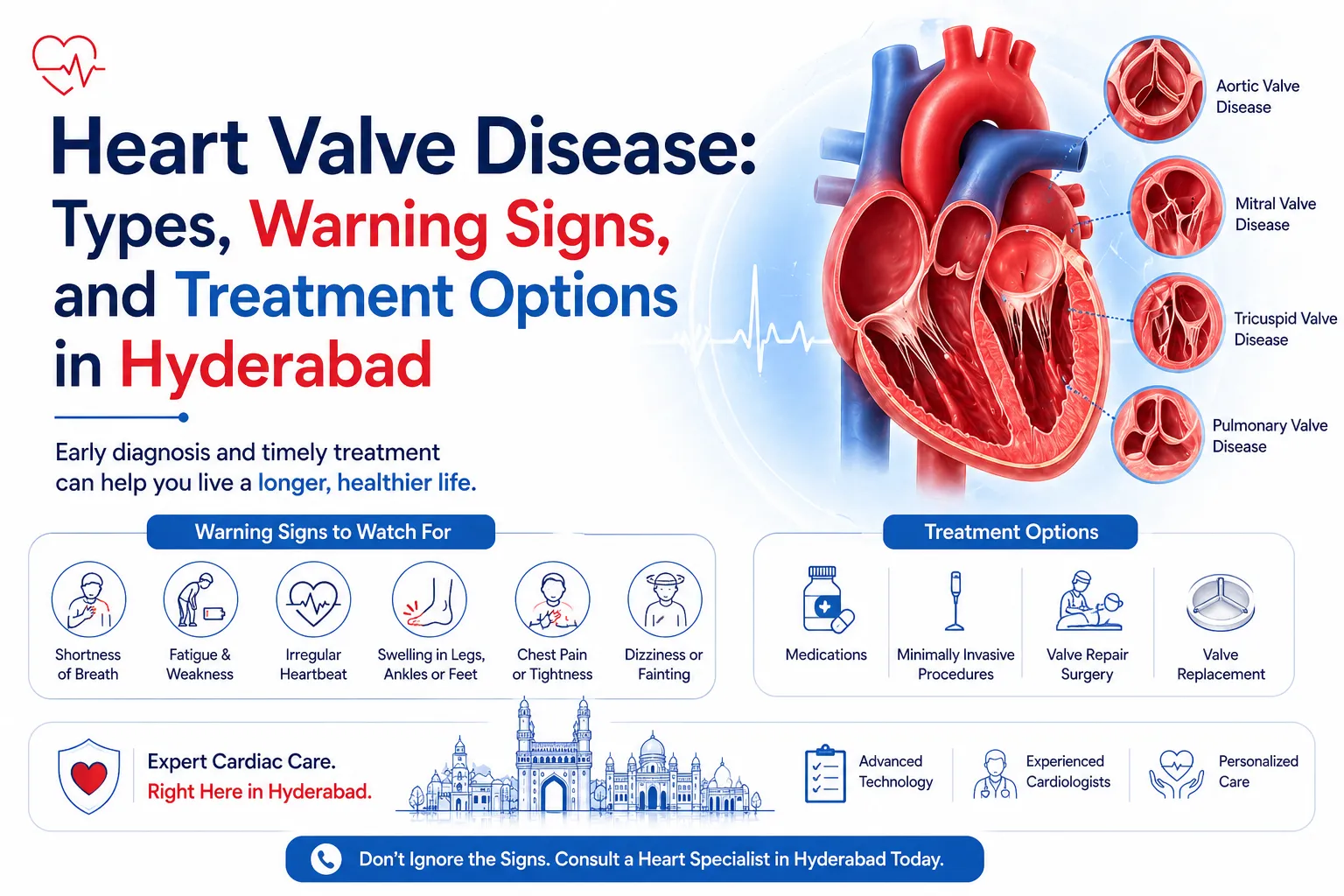
Let me start with something I hear quite often in my clinic: "Doctor, I was told I have a heart murmur years ago, but nobody ever followed up on it." If that sounds familiar, you are not alone. Heart valve disease is one of those conditions that can quietly progress over many years without causing obvious symptoms, and by the time most patients come to see me, the disease has already reached a moderate or advanced stage.
As a cardiologist seeing patients from Attapur and across Hyderabad, I want to walk you through what heart valve disease actually is, how to recognize it early, and what treatment paths are available right here in the city. Whether you are dealing with mitral valve disease in Hyderabad or have been referred for echocardiography valve assessment, this guide is for you.
Your heart has four valves: the mitral valve, the aortic valve, the tricuspid valve, and the pulmonary valve. Each of these acts like a one-way door, ensuring blood flows in the right direction through the chambers of your heart and out to your body and lungs.
When one or more of these valves does not open or close properly, we call it valvular heart disease. There are two main problems that can occur:
• Stenosis: The valve opening becomes narrow or stiff, making it harder for blood to pass through.
• Regurgitation (also called insufficiency or leakage): The valve does not close tightly, allowing blood to flow backward.
Both conditions put extra strain on your heart. Over time, if left untreated, the heart muscle can weaken and lead to heart failure.
Here is an overview of the most commonly seen valve conditions in clinical practice:
Among these, aortic stenosis and mitral valve regurgitation are the two conditions I encounter most frequently in patients coming to me for heart valve disease treatment in Hyderabad. Rheumatic heart disease causing mitral stenosis is also still widely seen, particularly in patients who had strep throat infections in childhood that were not fully treated.
One of the biggest challenges with heart valve disease is that it can be completely silent for years. Many patients feel fine until the heart starts to compensate less effectively. Here are the warning signs that should prompt an immediate visit to a valvular disease cardiologist in Attapur or your nearest cardiac facility:
I always tell my patients: do not wait until your symptoms are severe. If you experience even mild breathlessness on climbing stairs that was not there six months ago, please come in. These early symptoms are the window of opportunity where we can intervene most effectively.
Diagnosis begins with a thorough clinical examination. If I hear an abnormal heart sound through my stethoscope, the next step is almost always an echocardiogram.
Echocardiography for valve assessment is the single most important test for evaluating heart valve disease. It is a painless ultrasound of the heart that gives us detailed information about:
• The structure and movement of each valve
• The severity of stenosis or regurgitation
• The size and function of the heart chambers
• The pressure gradients across the valves
• Whether the heart muscle has started to weaken
In many cases, I also request a transesophageal echocardiogram (TEE), where a small probe is passed through the esophagus for a closer view of the valves, particularly the mitral valve. This gives much clearer images than a standard chest echo.
• ECG (Electrocardiogram): Checks heart rhythm and electrical activity
• Chest X-Ray: Looks for heart enlargement or fluid in the lungs
• Cardiac CT or MRI: Used in complex cases, particularly before surgery
• Cardiac Catheterization: Measures pressures inside the heart and coronary artery status before valve surgery
Treatment depends on the type of valve affected, the severity of the disease, your symptoms, and your overall health. Let me walk you through the main options:
Not every patient with valve disease needs a procedure right away. For mild or moderate cases, medications help manage symptoms and reduce the workload on the heart. These include diuretics to reduce fluid buildup, ACE inhibitors or ARBs to lower blood pressure and reduce heart strain, beta-blockers to control heart rate, and blood thinners for patients with atrial fibrillation or mechanical valves.
Important note: medications do not repair or replace a damaged valve. They buy time and help manage symptoms, but in severe valve disease, the definitive treatment is almost always procedural or surgical.
This is a catheter-based procedure where a thin tube is inserted through the groin and guided to the narrowed valve. A balloon at the tip is inflated to stretch the valve open. This works well for mitral stenosis due to rheumatic heart disease and for pulmonary stenosis. It is not suitable for calcified aortic stenosis in most adults.
When possible, I always prefer repairing a patient's own valve rather than replacing it. Valve repair preserves natural anatomy and generally carries better long-term outcomes. It is most commonly done for the mitral valve. The surgeon reshapes, restructures, or reinforces the valve using sutures or a prosthetic ring.
When repair is not feasible, the diseased valve is replaced with either a mechanical valve or a biological (bioprosthetic) valve. Mechanical valves last a lifetime but require blood-thinning medication permanently. Biological valves, made from animal or human tissue, do not need long-term blood thinners but may wear out after 10 to 20 years and require re-intervention.
Valve replacement surgery is now routinely performed in Hyderabad at specialized cardiac centers with excellent outcomes.
This is one of the most significant advances in cardiac care in recent decades. TAVI allows us to replace a severely narrowed aortic valve without open-heart surgery. A compressed replacement valve is delivered through a catheter via the groin artery and expanded inside the diseased valve.
Originally developed for high-risk or elderly patients who could not tolerate surgery, TAVI is now being used in intermediate-risk and even low-risk patients in selected cases. It is available at leading cardiac hospitals in Hyderabad and has transformed outcomes for aortic stenosis patients.
For patients with severe mitral valve regurgitation who are too high-risk for open surgery, the MitraClip procedure offers a catheter-based solution. A small clip is delivered through the groin and across to the mitral valve, where it grasps and brings together the leaking valve leaflets. This reduces regurgitation without the need for open-heart surgery.
Every patient is different. When I sit down with a patient and their family to discuss treatment for valve disease, the conversation includes several important factors:
• Severity of valve disease on echocardiography
• Presence and severity of symptoms
• Left ventricular function (how well the heart is pumping)
• Age and overall fitness for surgery
• Presence of other medical conditions like diabetes, kidney disease, or prior strokes
• Patient preference regarding long-term anticoagulation for mechanical valves
I want my patients to be active participants in these decisions. Heart valve surgery is a significant undertaking, and it is important that you understand your options, the risks involved, and what to expect during recovery.
For patients who are being monitored or managed medically, regular follow-up is essential. Echocardiography valve assessment is typically repeated every six to twelve months for moderate disease and annually for mild disease. Any worsening of symptoms should be reported promptly.
Lifestyle adjustments also matter. Staying active within your limits, eating a heart-healthy diet, avoiding smoking, managing blood pressure and diabetes, and maintaining a healthy weight all help reduce the progression of valve disease.
If you have been told you have a heart murmur and have never had a proper evaluation, please do not wait. A valvular disease cardiologist in Attapur can quickly perform an echocardiogram and tell you exactly where you stand.
Please seek urgent cardiac evaluation if you experience any of the following:
• Sudden severe breathlessness at rest
• Chest pain with exertion
• Fainting or near-fainting episode
• Rapid or very irregular heartbeat that is new
• Coughing up pink or frothy fluid
These can be signs of a cardiac emergency and require same-day evaluation.
Heart valve disease is very much a treatable condition when caught and managed at the right time. The days of it being a death sentence are long behind us. With advances in echocardiographic diagnosis, minimally invasive procedures like TAVI and MitraClip, and skilled surgical teams available right here in Hyderabad, the outcomes for patients with valve disease have never been better.
My advice to you is simple: listen to your body, do not ignore symptoms like breathlessness or fatigue, and please get that echocardiogram done if your doctor has been recommending it. If you need heart valve disease treatment in Hyderabad or have concerns about mitral valve disease, reach out to a qualified cardiologist who can guide you through every step of the journey.
Your heart valves work tirelessly every second of your life. When they need help, do not hesitate to ask for it.
References
1. Nishimura RA, Otto CM, Bonow RO, et al. 2014 AHA/ACC Guideline for the Management of Patients with Valvular Heart Disease. Journal of the American College of Cardiology. 2014;63(22):e57-e185. doi:10.1016/j.jacc.2014.02.536
2. Vahanian A, Beyersdorf F, Praz F, et al. 2021 ESC/EACTS Guidelines for the Management of Valvular Heart Disease. European Heart Journal. 2022;43(7):561-632. doi:10.1093/eurheartj/ehab395
3. Otto CM, Nishimura RA, Bonow RO, et al. 2020 ACC/AHA Guideline for the Management of Patients with Valvular Heart Disease. Circulation. 2021;143(5):e72-e227. doi:10.1161/CIR.0000000000000923
4. Lancellotti P, Tribouilloy C, Hagendorff A, et al. Recommendations for the Echocardiographic Assessment of Native Valvular Regurgitation. European Journal of Echocardiography. 2013;14(6):611-644. doi:10.1093/ejechocard/jet105
5. Mack MJ, Leon MB, Thourani VH, et al. Transcatheter Aortic-Valve Replacement with a Balloon-Expandable Valve in Low-Risk Patients. New England Journal of Medicine. 2019;380(18):1695-1705. doi:10.1056/NEJMoa1814052
6. Feldman T, Foster E, Glower DD, et al. Percutaneous Repair or Surgery for Mitral Regurgitation (EVEREST II). New England Journal of Medicine. 2011;364(15):1395-1406. doi:10.1056/NEJMoa1009355
7. World Health Organization. Rheumatic Heart Disease. WHO Fact Sheets. Geneva: WHO; 2020.
8. Indian Heart Association. Cardiovascular Disease Risk in South Asians. IHA Report. 2022.
9. Chandrashekhar Y, Westaby S, Narula J. Mitral Stenosis. Lancet. 2009;374(9697):1271-1283. doi:10.1016/S0140-6736(09)60094-2
10. Chambers JB. Valvular Heart Disease. Thorax. 2004;59(12):1107-1112. doi:10.1136/thx.2003.011668
This blog is intended for general informational purposes only and does not constitute medical advice. Please consult a qualified cardiologist for diagnosis and treatment of any heart condition.