10 Massages and Stretches for a Frozen Shoulder
June 15, 2023
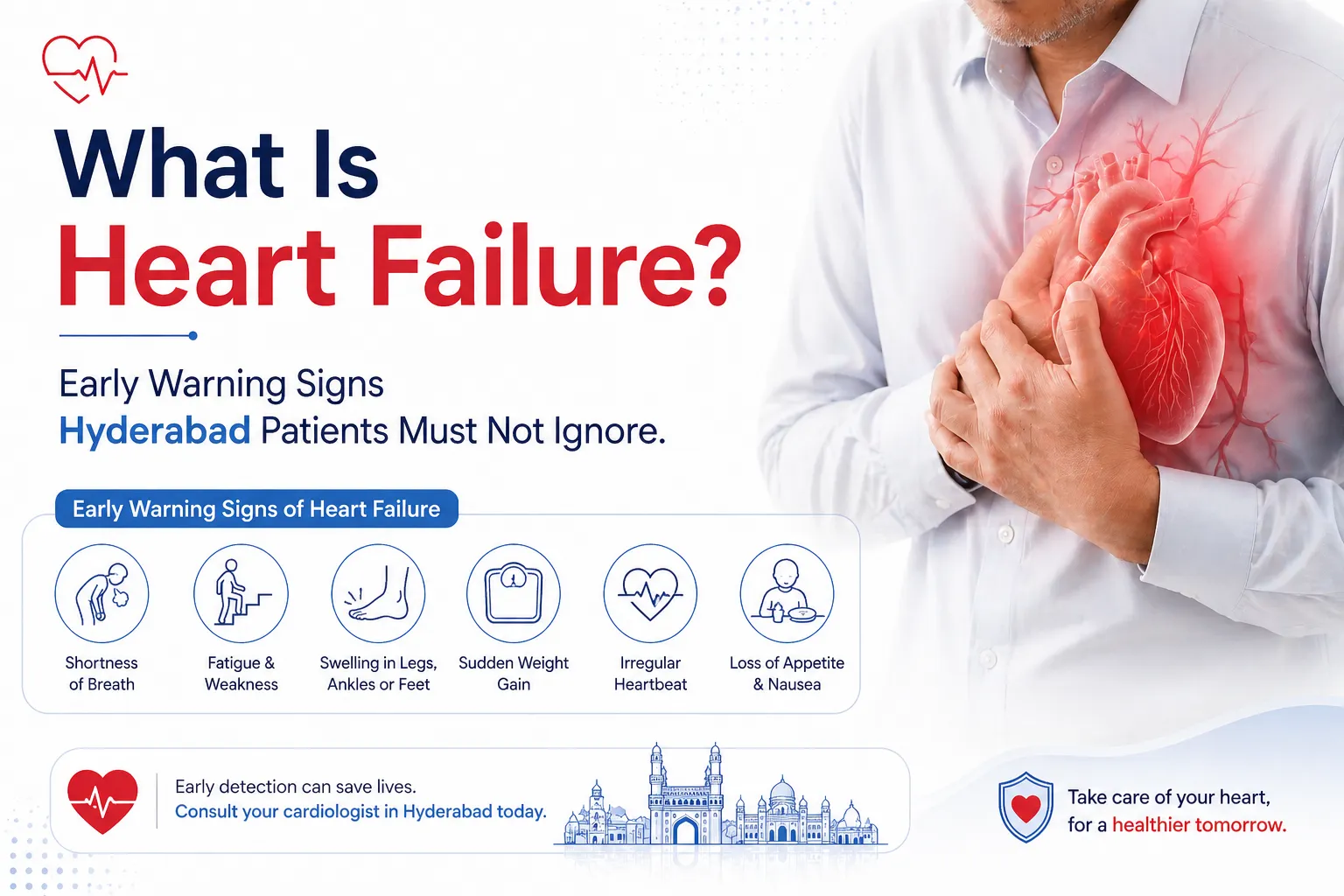
I want to begin by clearing up one of the most common misunderstandings I encounter in my clinic every single week. When patients hear the words heart failure, they immediately assume it means the heart has stopped working entirely. I can see the fear on their faces. But that is not what heart failure means at all.
Heart failure is a condition where your heart is still beating, but it is not pumping blood as efficiently as your body needs. Think of it like a pump that has lost some of its power. It is still running, but it is struggling to keep up with demand. And because of that struggle, your body starts sending you signals. Those signals are the early warning signs that we, as cardiologists, need you to pay attention to.
As a heart failure doctor in Attapur seeing patients from across Hyderabad, I want this blog to help you understand what heart failure is, how to spot it early, and what your options are for congestive heart failure treatment in Hyderabad.
Your heart pumps blood through two circuits. The right side receives oxygen-poor blood from the body and sends it to the lungs to pick up oxygen. The left side receives oxygen-rich blood from the lungs and pumps it out to the rest of the body. When either or both sides of the heart lose the ability to pump effectively, we call it heart failure.
There is an important number called the ejection fraction, or EF, which measures the percentage of blood the left ventricle pumps out with each beat. A healthy heart has an ejection fraction of around 55 to 65 percent. In heart failure, this number can be reduced significantly, though as you will see below, some patients with heart failure actually have a preserved ejection fraction.
Heart failure is not a single condition. There are several types, and understanding which type a patient has guides the choice of treatment. Here is a summary:
In my practice in Hyderabad, I see all these types regularly. HFrEF (systolic failure) is common in patients with prior heart attacks or coronary artery disease. HFpEF (diastolic failure) is increasingly common in older patients, particularly those with long-standing high blood pressure or diabetes. Understanding which type you have matters enormously for your treatment plan.
Heart failure is a result of damage or sustained stress to the heart muscle. The most common causes I see in Hyderabad patients include:
• Coronary artery disease and previous heart attacks: When part of the heart muscle dies from a blocked artery, the remaining muscle has to work harder.
• Long-standing high blood pressure (hypertension): Forces the heart to pump against resistance for years, eventually weakening the muscle.
• Diabetes: Damages both the blood vessels supplying the heart and the heart muscle itself.
• Valvular heart disease: Leaking or narrowed valves increase cardiac workload over time.
• Cardiomyopathy: Disease of the heart muscle itself, which can be genetic, alcohol-related, or secondary to viral infections.
• Thyroid disease: Both overactive and underactive thyroid can impair cardiac function.
• Chronic kidney disease: Places significant additional demand on the cardiovascular system.
• Arrhythmias: Persistent rapid or irregular heart rhythms can weaken the heart over time.
Many patients in Hyderabad carry multiple risk factors simultaneously. Uncontrolled hypertension, diabetes, and obesity together create a particularly challenging environment for the heart.
This is the most important section of this blog. The reason I emphasise early detection so strongly is that heart failure caught early responds far better to treatment. Patients who come to me at NYHA Class I or II almost always do better in the long run than those who present at Class III or IV.
Please read through this table carefully. If you or someone you care about has two or more of these symptoms together, please do not delay seeking a cardiac evaluation:
Let me highlight three of these that patients most commonly dismiss or attribute to something else.
I cannot count how many patients have told me they assumed getting breathless climbing to the second floor was just a sign of being unfit or getting older. In a city like Hyderabad where the heat and humidity are significant factors, many people write off breathlessness as the weather. Please do not do this. Breathlessness that is worsening gradually over months, especially if it is now happening at lower levels of activity than before, deserves a proper cardiac evaluation including an echocardiogram and BNP blood test.
Oedema (swelling) of the ankles is another warning sign that patients often attribute to standing for long periods, dietary salt, or hot weather. While these can contribute to mild ankle swelling, persistent pitting oedema that gets worse during the day and does not completely resolve overnight after elevating the legs is a genuine red flag for right-sided heart failure or biventricular failure.
I ask all my heart failure patients to weigh themselves every morning, before breakfast, after using the toilet. A weight gain of more than 1 to 2 kilograms in a period of two to three days is almost always fluid retention and a sign that heart failure is becoming less controlled. This simple habit has saved many of my patients an emergency hospital admission.
Cardiologists use a simple classification system developed by the New York Heart Association (NYHA) to grade the severity of heart failure based on your functional capacity. This helps us track your progress and adjust treatment:
Most patients I see in the outpatient clinic are in Class II or Class III. Class IV patients usually require hospitalisation for stabilisation before we can begin long-term management. The goal of treatment is always to move you down the scale from a higher class to a lower one.
If I suspect heart failure based on your symptoms and examination, I will arrange a combination of the following tests:
• BNP or NT-proBNP: This is a hormone released by a stressed heart. Elevated levels are a strong indicator of heart failure and help us judge severity and response to treatment.
• Kidney function, electrolytes, liver function: To assess the downstream effects of poor cardiac output.
• Thyroid function, haemoglobin, blood glucose: To identify reversible contributing causes.
This is the cornerstone investigation. An echocardiogram tells me your ejection fraction, how well each chamber is filling and emptying, the state of your valves, and any structural abnormality. It is painless, takes about 30 minutes, and is widely available in Hyderabad.
An ECG can reveal underlying arrhythmias, prior heart attacks, or conduction abnormalities. A chest X-ray can show an enlarged heart shadow and fluid in the lungs (pulmonary oedema), which are classic findings in decompensated heart failure.
In selected cases, particularly when the cause of heart failure is unclear, a cardiac MRI gives exquisite detail about the heart muscle. Stress testing helps assess functional capacity and identify hidden coronary disease.
The good news is that heart failure is very treatable. Over the past two decades, we have accumulated an impressive arsenal of medications and devices that substantially reduce hospitalisations, improve quality of life, and extend survival. Here is an overview:
For patients with reduced ejection fraction heart failure, there are now four medication classes with overwhelming evidence for survival benefit. I call them the fantastic four:
• ACE inhibitors or ARBs (or the newer ARNI combination of sacubitril and valsartan): Reduce cardiac stress and slow disease progression.
• Beta-blockers (carvedilol, bisoprolol, or metoprolol succinate): Slow the heart rate and reduce harmful stress hormones.
• Mineralocorticoid receptor antagonists (spironolactone or eplerenone): Reduce fluid retention and cardiac fibrosis.
• SGLT2 inhibitors (dapagliflozin or empagliflozin): Originally developed for diabetes, these drugs have proven extraordinary benefits in heart failure across both HFrEF and HFpEF.
The goal is to get all four classes on board at the highest tolerated doses as quickly as safely possible. This approach has transformed outcomes for heart failure patients.
For patients with very low ejection fraction (below 35%) despite optimal medical therapy, we consider device-based treatments. An ICD (implantable cardioverter-defibrillator) protects against sudden cardiac death from dangerous arrhythmias. CRT (cardiac resynchronisation therapy) helps both sides of the heart beat in coordinated fashion, improving pumping efficiency. These procedures are performed by specialist electrophysiologists at leading cardiac centres in Hyderabad.
For a small number of patients with end-stage heart failure who no longer respond to medications or devices, heart transplantation or a left ventricular assist device (LVAD) may be considered. These are complex, resource-intensive options, but they are available at tertiary cardiac centres in Hyderabad for carefully selected patients.
One of the most powerful things you can do as a heart failure patient is monitor yourself consistently at home. I recommend my patients follow these daily habits:
• Weigh yourself every morning on the same scale, at the same time, wearing the same clothing. Record the number.
• Check your ankles every evening for new or worsening swelling.
• Monitor your blood pressure and heart rate if you have a home device.
• Keep a symptom diary noting any new breathlessness, fatigue, or reduced exercise tolerance.
• Restrict dietary salt to less than 2 grams per day, which means avoiding added salt, pickles, processed foods, and restaurant meals with high sodium.
• Fluid restriction to 1.5 to 2 litres per day may be recommended in moderate to severe cases.
• Take all medications exactly as prescribed and do not stop them without discussing with your cardiologist.
Please call for emergency assistance or go directly to a cardiac emergency unit if you experience any of the following:
• Sudden severe breathlessness at rest that does not improve with sitting upright
• Coughing up pink or frothy phlegm
• Chest pain with breathlessness
• Fainting or near-fainting
• Confusion, extreme drowsiness, or inability to be roused
• Weight gain of more than 2 kilograms in a single day
Heart failure is one of the most common reasons patients end up in hospital in India. In Hyderabad, with our high rates of hypertension, diabetes, and coronary artery disease, the burden is particularly significant. But here is what I want you to hold onto: this condition is manageable, and for many patients, quality of life with good cardiac care is excellent.
The key is catching it early, treating it aggressively, and committing to lifelong monitoring and lifestyle changes. If you have been told your heart is not pumping well, or if you have been experiencing unexplained breathlessness, fatigue, or ankle swelling, please do not put off your appointment.
Finding a trusted heart failure doctor in Attapur or anywhere in Hyderabad who can guide you through this journey makes an enormous difference. Together, we can manage heart failure symptoms in Hyderabad, keep you out of hospital, and help you live well for many years to come.
References
1. McDonagh TA, Metra M, Adamo M, et al. 2021 ESC Guidelines for the Diagnosis and Treatment of Acute and Chronic Heart Failure. European Heart Journal. 2021;42(36):3599-3726. doi:10.1093/eurheartj/ehab368
2. Heidenreich PA, Bozkurt B, Aguilar D, et al. 2022 AHA/ACC/HFSA Guideline for the Management of Heart Failure. Journal of the American College of Cardiology. 2022;79(17):e263-e421. doi:10.1016/j.jacc.2021.12.012
3. Ponikowski P, Voors AA, Anker SD, et al. 2016 ESC Guidelines for the Diagnosis and Treatment of Acute and Chronic Heart Failure. European Heart Journal. 2016;37(27):2129-2200. doi:10.1093/eurheartj/ehw128
4. McMurray JJV, Solomon SD, Inzucchi SE, et al. Dapagliflozin in Patients with Heart Failure and Reduced Ejection Fraction (DAPA-HF). New England Journal of Medicine. 2019;381(21):1995-2008. doi:10.1056/NEJMoa1911303
5. Packer M, Anker SD, Butler J, et al. Cardiovascular and Renal Outcomes with Empagliflozin in Heart Failure (EMPEROR-Reduced). New England Journal of Medicine. 2020;383(15):1413-1424. doi:10.1056/NEJMoa2022190
6. Anker SD, Butler J, Filippatos G, et al. Empagliflozin in Heart Failure with a Preserved Ejection Fraction (EMPEROR-Preserved). New England Journal of Medicine. 2021;385(16):1451-1461. doi:10.1056/NEJMoa2107038
7. Yancy CW, Jessup M, Bozkurt B, et al. 2017 ACC/AHA/HFSA Focused Update of the 2013 ACCF/AHA Guideline for the Management of Heart Failure. Circulation. 2017;136(6):e137-e161. doi:10.1161/CIR.0000000000000509
8. Reddy YNV, Borlaug BA. Heart Failure with Preserved Ejection Fraction. Current Problems in Cardiology. 2016;41(4):145-188. doi:10.1016/j.cpcardiol.2015.12.003
9. Guha K, McDonagh T. Heart Failure Epidemiology: European Perspective. Current Cardiology Reviews. 2013;9(2):123-127. doi:10.2174/1573403X11309020005
Disclaimer: This blog is intended for general informational purposes only and does not constitute medical advice. Please consult a qualified cardiologist for personalised diagnosis and treatment of any heart condition.